
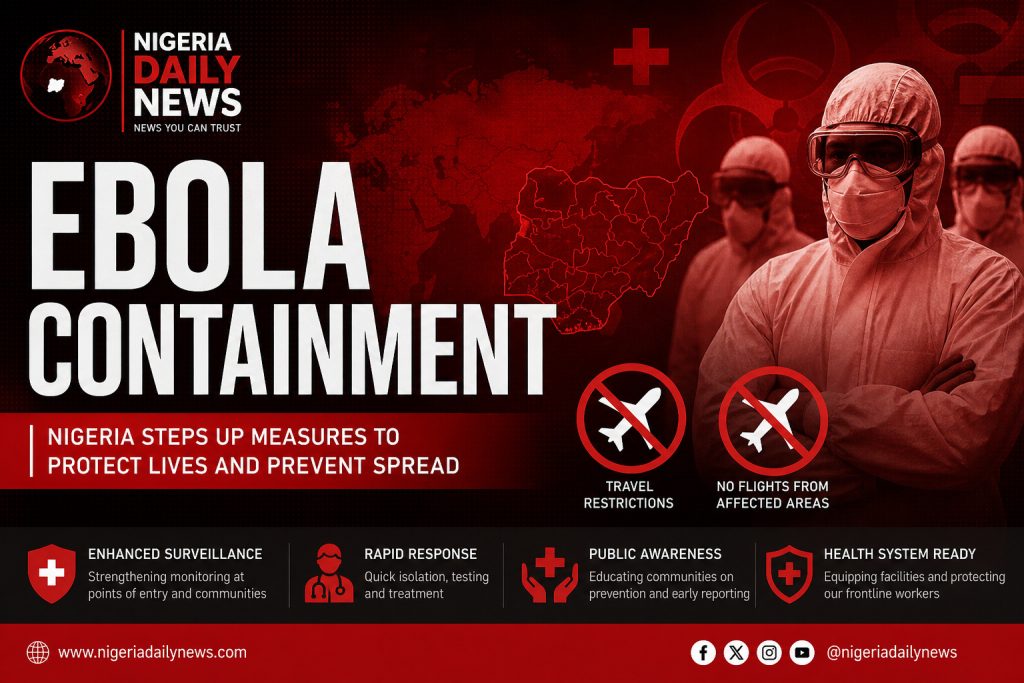
The Federal Government of Nigeria has ordered that 46 persons who came into contact with an Ebola patient be placed on a 21-day no-fly list as part of containment efforts against the country’s first confirmed Ebola case since 2014.
Minister Issues Directive
Federal Minister of Aviation and Aerospace Development, Festus Keyamo, directed the Nigeria Civil Aviation Authority (NCAA) to notify all local and international airlines to enforce the travel restriction on the identified individuals.
The directive followed a virtual meeting held by Keyamo on Wednesday with the Coordinating Minister of Health and Social Welfare, Professor Muhammad Ali Pate, to coordinate measures for containing the outbreak.
Patient Profile and Diagnosis
The index patient, a female diplomat, was diagnosed with the Bundibugyo strain of the Ebola virus disease on October 20, 2026, following laboratory tests. According to the World Health Organization (WHO), the patient had recently travelled from Uganda to Nigeria. Her symptoms first appeared on October 7, four days after her arrival.
She sought treatment at a private health facility in Abuja on October 11, where she was initially managed for malaria-like symptoms. However, her condition failed to improve, prompting doctors to investigate her travel history—a decision that ultimately led to the Ebola diagnosis.
Key Facts:
-
Strain: Bundibugyo (no approved vaccine or specific treatment currently available)
-
Incubation Period: 2 to 21 days
-
Patient Status: In isolation receiving medical care; condition deteriorated to multi-organ failure
-
Nationality: Not officially disclosed
Contact Tracing Results
Dr. Olajumoke Babatunde, Director of Public Health Laboratory Services at the Nigeria Centre for Disease Control (NCDC), confirmed the Bundibugyo strain during an emergency incident management meeting in Abuja on Wednesday.
“We did three levels of tests, but all were molecular. The strain was Bundibugyo,” Dr. Babatunde stated.
Coordinating Minister Pate provided the Aviation Minister with details of all contacts identified during investigations. He shared a list of 44 persons who came into contact with the affected person at the hospital when she developed symptoms, plus two additional persons who are her domestic staff—bringing the total to 46 individuals on the no-fly list.
Airport Surveillance Intensified
Minister Keyamo also ordered the Federal Airports Authority of Nigeria (FAAN) to intensify Ebola response and surveillance measures across all international airports. Measures already being implemented include:
-
Enhanced health screenings
-
Temperature checks
-
Travel history tracking
-
Digital health declarations
-
Strict inter-agency coordination with the NCDC
“Whilst efforts are ongoing to isolate them for now until there is certainty they had not been infected with the virus, the aviation authorities are required to put them on a no-fly list for at least 21 days,” Keyamo said.
WHO Response
The World Health Organization has confirmed the infection and stated that investigations are ongoing to establish the likely source and reconstruct the patient’s full travel and exposure history.
The WHO and its partners are supporting Nigerian health authorities with case investigation, contact tracing, infection prevention and control, and the provision of essential supplies—including personal protective equipment for health workers. The organisation has also urged countries in the region to strengthen disease surveillance, laboratory testing, rapid-response capacity, and monitoring at points of entry.
Public Health Context
Ebola spreads through direct contact with the blood or other bodily fluids of symptomatic infected persons, or through contact with contaminated materials. The virus carries an incubation period ranging from two to 21 days, making the identification and monitoring of exposed persons critical to containing transmission.
Nigeria previously contained an Ebola outbreak in 2014 after the virus was introduced by an infected traveller. That response involved coordinated isolation, extensive contact tracing, and decisive public health action.
For the current case, immediate priorities include monitoring identified contacts, strengthening infection prevention at the hospital where the patient received treatment, and maintaining heightened surveillance at airports and other points of entry.
About The Author



More Stories
Liverpool’s Teen Sensation Rio Ngumoha Steals the Show in Champions League Thriller
Trump DOJ Sues to Block Alaska Senate Results if Incumbent Sullivan Loses
DOJ Orders California Counties to Set Aside Ballots From Suspected Noncitizens